
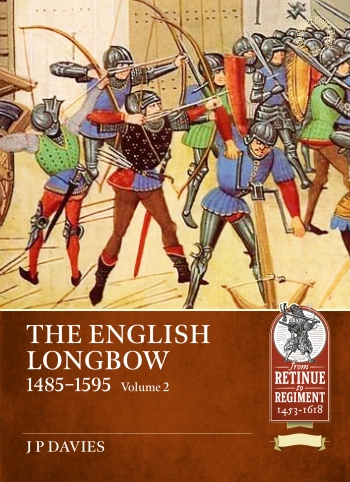
The English Longbow 1485-1595 Volume 2
Series : From Retinue to Regiment 1453-1618
Author : Jonathan Davies
Print Editions
Paperback
Not yet published - in Autumn 2026 list
Details
General - Pages : 324 | Images : 25 b/w illustrations, 25 b/w photos, 12 colour illustrations, 12 colour photos, 5 b/w maps, 10 figures, 20 tables
Paperback - Size : 248mm x 180mm | ISBN : 9781804518359 | Helion Book Code : HEL2048
In 1485, the English longbow remained one of the most celebrated weapons in European warfare, its formidable reputation established during the Hundred Years' War and the Wars of the Roses. Yet little more than a century later, in 1595, it was officially declared obsolete for military service. Why did a weapon so deeply embedded in English military tradition disappear from the battlefield? Was its replacement by firearms simply the inevitable triumph of superior technology, or were more complex forces at work?
In The English Longbow – Investigating a Myth, Volume 2: From Renown to Rejection, 1485–1603, Jonathan Davies challenges conventional interpretations of the Tudor longbow and its eventual abandonment. Drawing upon extensive contemporary documentary evidence, surviving artefacts and modern experimental research, he examines the construction and performance of the warbow, its arrows and associated equipment, and the practical realities of its employment. Particular attention is devoted to the remarkable archery finds from the Mary Rose, alongside modern trials investigating the longbow's range, accuracy, rate of shooting and effectiveness against armour.
The book explores the changing tactical role of archery through the major conflicts of the Tudor period, from Stoke Field and Flodden to the campaigns of Henry VIII, the Battle of Pinkie and the rebellions of 1549. It considers the continuing strengths and limitations of the bow as English armies increasingly encountered the pikes and firearms of Continental warfare. Davies also investigates the everyday practice of archery in Tudor England, drawing upon the detailed inventory of Henry VIII's military equipment in 1547, contemporary legislation and the fascinating evidence of sixteenth-century coroners' records to establish who practised archery, how and where they shot, and the importance of the bow within English society.
Central to this study is a critical reassessment of the famous 'bow versus gun' debate. Davies examines the arguments of contemporary military writers, the emergence of the trained bands, and the transformation of recruitment, discipline and military organisation that accompanied the adoption of firearms. He demonstrates that the longbow's disappearance cannot be understood through technological change alone, but must also be considered within the wider evolution of the English state, its armies and the men who served in them. The narrative concludes with the longbow's final rejection as a military weapon, subsequent attempts at its revival, and its enduring place in English historical mythology.
The product of more than thirty years of research and practical experience, this extensively illustrated volume includes historical images, photographs of surviving artefacts and carefully researched reconstructions, tactical diagrams, maps and colour plates depicting the archers, equipment and weapons of Tudor England. Together, the two volumes of The English Longbow – Investigating a Myth offer a comprehensive and thought-provoking reassessment of one of the most famous weapons in military history, challenging long-established assumptions about its capabilities, achievements and ultimate fate.