
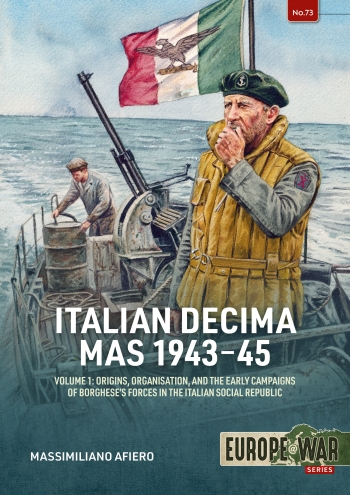
Italian Decima MAS 1943-45 Volume 1
Origins, organisation, and the early campaigns of Borghese's forces in the Italian Social Republic
Series : Europe@War #73
Author : Massimiliano Afiero
Print Editions
Paperback
Not yet published - in Autumn 2026 list
Details
General - Pages : 110 | Images : 144 b/w photos, 1 b/w illustration, 7 colour photos, 5 colour illustrations, 5 colour maps, 4 diagrams
Paperback - Size : 297mm x 210mm | ISBN : 9781804519608 | Helion Book Code : HEL2077
The Decima MAS occupies a unique and deeply controversial place in the military history of the Second World War. Celebrated for the spectacular exploits of its underwater and surface raiders during the Mediterranean war, after the Italian armistice of September 1943 it was transformed under Commander Junio Valerio Borghese into something very different: an autonomous naval and land force fighting on the side of the Italian Social Republic and its German ally.
In this first of two volumes, noted Italian military historian Massimiliano Afiero traces the Decima from its origins in the Regia Marina’s pioneering assault-craft units through the crisis of 8 September 1943 and the extraordinary expansion that followed. Refusing to disband his command, Borghese negotiated an agreement with the German Kriegsmarine that preserved the Decima’s Italian identity and a remarkable degree of autonomy. Volunteers soon arrived from across the former Italian armed forces, and what had been an elite specialist flotilla developed into a complex organisation encompassing MAS boats and assault craft, midget submarines, combat swimmers, marine infantry, parachute swimmers, engineers and artillery. By May 1944 its growing ground forces had been brought together as the Decima Division.
Afiero follows this transformation in detail, examining the Decima’s organisation, uniforms, weapons and specialist units as well as the political struggles surrounding Borghese and his determination to preserve the formation’s independence. The naval war continued, with MAS boats and assault craft operating against Allied shipping off the Lazio coast, while on land the Barbarigo Battalion was committed to the Anzio–Nettuno front, where it fought alongside German forces through the bitter battles and withdrawal of the spring of 1944.
The volume also charts the training and deployment of the Decima’s other formations, including the Lupo, Fulmine, Tarigo and Parachute Swimmer battalions, and the regrouping of the division in Piedmont. There, the Decima became increasingly drawn into Italy’s civil war and anti-partisan operations – a development that brought it into some of the most bitter and controversial episodes of its history. The narrative does not shy away from this darker dimension: the manuscript itself records the torture and execution of partisan Ferruccio Nazionale and the controversy that followed.
Based on archival documentation, contemporary accounts and the testimony of participants, Italian Decima MAS 1943-45 Volume 1 combines detailed operational history with the visual approach that characterises Helion’s Europe@War series. Profusely illustrated with wartime photographs, maps and specially commissioned colour artwork, it provides a detailed account of the organisation, personnel, equipment and early campaigns of one of the most unusual military formations of wartime Italy. The colour plates range from Decima MAS ratings and pocket-submarine personnel to Group Gamma combat swimmers and officers of the Lupo and Barbarigo battalions.