
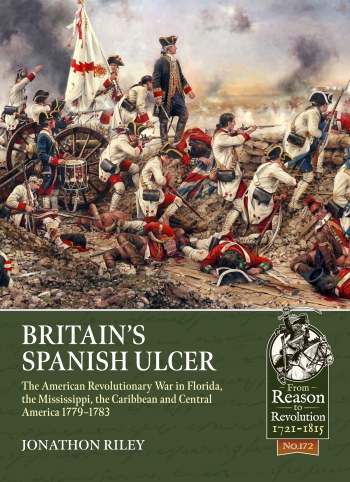
Britain's Spanish Ulcer
The American Revolutionary War in Florida, the Mississippi, the Caribbean and Central America, 1779-1783
Series : From Reason to Revolution 1721-1815 #172
Author : Jonathon Riley
Print Editions
Paperback
£29.95 FREE UK delivery on orders over £30
Despatched within 1-2 working days
Details
General - Pages : 284 | Images : 99 b/w illustrations, 54 b/w maps
Paperback - Date of Publication : 27th September 2026 | Size : 248mm x 180mm | ISBN : 9781806722587 | Helion Book Code : HEL2250


Click images to enlarge
The American Revolutionary War was not fought – or won – only at Lexington, Saratoga and Yorktown. Far to the south, from the Mississippi Valley and the Floridas to the Caribbean and Central America, Britain was fighting another war: one against Spain and France that consumed troops, ships, money and attention at precisely the moment they were most needed elsewhere. What British commanders initially dismissed as a collection of sideshows became a strategic ulcer that helped create the conditions for ultimate defeat.
Britain’s Spanish Ulcer restores this neglected southern and Caribbean war to the wider history of the American Revolution. Jonathon Riley examines the enormous financial and material assistance supplied to the American cause by Britain’s European enemies, before tracing their direct entry into the conflict. Spain’s contribution was particularly significant: its wealth helped sustain both the Americans and the French, while its own forces sought revenge for the humiliations of the Seven Years War and the recovery of territories lost to Britain in 1763.
At the centre of the story is Bernardo de Gálvez, Governor of Louisiana and one of the outstanding commanders of the war. Riley follows Gálvez’s remarkable campaigns along the Mississippi, the capture of Baton Rouge and Mobile, and the climactic siege of Pensacola in 1781. The fall of Pensacola removed British power from West Florida only months before Cornwallis surrendered at Yorktown and forced Britain to devote still more resources to the defence of its remaining possessions.
But this was a war fought on a far greater scale. Riley ranges across the struggle for the Caribbean islands, the great naval campaigns and the Battle of the Saintes; British and Spanish operations in Guatemala and Nicaragua; the fighting in Honduras and on the Mosquito Coast; and the competing ambitions for Jamaica, the Bahamas and the Gulf of Mexico. Land campaigns, sieges, amphibious operations and fleet actions are placed alongside the problems of distance, supply, tropical disease, hurricanes, colonial politics and alliances with Native American peoples.
Drawing together British, Spanish, French and American evidence, including extensive archival material, Britain’s Spanish Ulcer presents the war as an interconnected struggle for empire rather than simply a rebellion in thirteen colonies. It concludes with the peace settlements of 1783 and their profound consequences: Britain lost Florida and its position in the Mississippi Valley, the United States gained the freedom to expand westwards, and Spain recovered territory only to confront the growing power of the new republic.
The result is a broader and more international account of the American Revolution – and a compelling reassessment of the Spanish contribution to Britain’s defeat.