
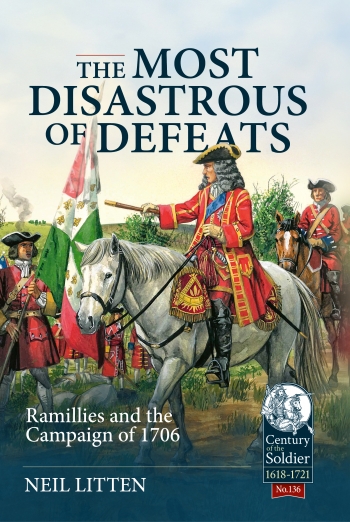
The Most Disastrous of Defeats
Ramillies and the Campaign of 1706
Series : Century of the Soldier 1618-1721 #136
Author : Neil Litten
Print Editions
Hardback
Not yet published - in Autumn 2026 list
Details
General - Pages : 384 | Images : 21 colour photos, 7 colour illustrations, 7 colour maps, 13 b/w maps, 1 b/w photo
Hardback - Size : 234mm x 156mm | ISBN : 9781806720194 | Helion Book Code : HEL2165
The 1706 campaign changed the War of the Spanish Succession. Within a few months French hopes of regaining the strategic initiative had gone, most of the Spanish Netherlands had been lost, and the Grand Alliance stood at the peak of its military fortunes. At the centre of the year was the Battle of Ramillies.
On 23 May, near a small village in Brabant, the Duke of Marlborough met an army of roughly his own strength under Marshal Villeroi and the Elector of Bavaria. In the space of a few hours the field army of the Two Crowns came apart. The consequences ran well beyond the battlefield: rather than fight again the French gave up huge tracts of territory, and Louis XIV was forced to draw troops from other theatres simply to rebuild in Flanders.
The Most Disastrous of Defeats is not, therefore, only the story of a battle. Neil Litten reconstructs the 1706 campaign as a whole, opening with the strategic frustrations left over from 1705 and Marlborough's abandoned plan to shift the war into Italy. He follows the competing French and Allied approaches as events in Spain, Italy and on the Rhine bore down on decisions in the Low Countries, and traces the two armies to their convergence at Ramillies and through the battle itself in unusually close tactical detail.
The victory opened a wholly new phase of the war. Marlborough pushed the collapse hard: Brussels, Antwerp, Ghent and Bruges all fell out of French hands, the Allied armies moved across Brabant and Flanders, and the fortresses of Ostend, Menin and Ath became the objects of major siege operations. Litten carries the story through the rest of the campaigning season — logistics, siege warfare, coalition command, troop movements, and the continuing French effort to rebuild an army capable of checking the Allied advance. As the year went on the campaign became entangled with growing disputes inside the Grand Alliance over the Dutch Barrier, the administration of the conquered provinces, competing priorities elsewhere, and proposals for peace. By December, the sheer scale of what had been won had begun to expose the political fractures that would in the end prevent Ramillies from producing a decisive settlement.
The author works from British, French, Dutch and German material, including the major manuscript holdings in London, Windsor, Vincennes, Paris and The Hague, and steps deliberately away from the older Anglocentric and Marlborough-centred accounts. He reassesses Villeroi, Louis XIV, the Dutch generals and their field deputies, and challenges a number of long-standing battlefield narratives that have persisted without support in the contemporary evidence. This extensively revised and expanded edition of the author’s earlier work on this battle draws on substantial new archival research, particularly in the French military records.
The narrative is backed by a large body of documentary and analytical material. Sixteen appendices give full orders of battle for both armies at Ramillies; troop strengths and national composition; regimental and campaign casualty returns; the captured colours; losses at the sieges of Ostend, Menin and Ath; the Menin garrison; a contemporary hospital return from Ghent; and the composition of the Allied force put together for the projected descent on France. With the maps and battlefield analysis, the volume works as both a narrative history and a reference on the armies and operations of 1706.
Ramillies was Marlborough's masterpiece, but the day itself cannot really be read apart from the campaign that flowed from it. The Most Disastrous of Defeats puts that whole campaign back at the centre of the story, and shows how one afternoon's fighting reshaped a year of operations, tilted the strategic balance across Europe, and — at the same moment — carried the Grand Alliance to its high point and planted the divisions that would come after.