
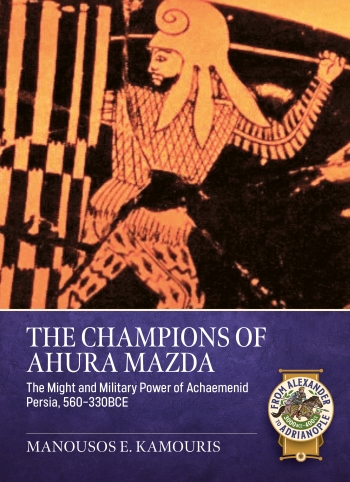
The Champions of Ahura Mazda
The Might and Military Power of Achaemenid Persia, 560-330 BCE
Series : From Alexander to Adrianople
Author : Manousos E. Kamouris
Print Editions
Paperback
Not yet published - in Spring 2027 list
Details
General - Pages : 288 | Images : 10 colour photos, 8 colour plates, 1 colour map, 14 b/w illustrations, 9 figures, 2 tables
Paperback - Size : 248mm x 180mm | ISBN : 9781806724949 | Helion Book Code : HEL2325
The ancient Persian Empire, ruled by the Achaemenid dynasty, dominated vast areas of Eurasia for more than two centuries. It was the fourth major empire to establish a unipolar order in Asia, but the first to do so on an intercontinental scale. At its height, the Achaemenid Empire had no true imperial rival.
Ironically, much of what we know about the Achaemenids comes from their great adversaries: the Greeks. Archaeological evidence provides invaluable insights into the Persian Empire, but it is the Greek historians who give its people life and context, recording their personalities, beliefs, priorities and methods. Herodotus, writing a generation after the Persian Wars, could admire Darius I despite his invasion of Greece and praise Cyrus the Great despite his conquest of the Greek communities of Asia Minor. Even Xerxes, whose invasion of Greece was accompanied by acts the Greeks regarded as barbarous, receives favourable treatment in places. Greek criticism was often directed less at the Persians themselves than at what Greek writers perceived as abuses of political, moral and religious power.
Thus, The Champions of Ahura Mazda draws predominantly on the extensive and detailed writings of Greek authors who sought to analyse their enemy, prepare for confrontation with them and learn from them. Although inevitably biased and, in many cases, inaccurate, these accounts provide a valuable portrait of the strengths and weaknesses of the Iranian character, aspects of which may remain relevant even today. Despite repeated changes in religion over the centuries, the Iranian people have demonstrated both an ability to adapt their allegiances and a fervent commitment to them once established. Archaeological evidence allows these Greek accounts to be cross-referenced and assessed, resulting in a more complete picture of an integrated and culturally diverse imperial power that waged wars on a vast scale, with spectacular, though sometimes ambivalent, results.