
The Battle of San Romano and the War of Lucca, 1429-1433
From contemporary chronicles and in the paintings of Paolo Uccello
Series : A Time of Knights
Author : Massimo Predonzani
Print Editions
Paperback
Not yet published - in Spring 2027 list
Details
General - Pages : 192 | Images : 8 colour illustrations, 30-40 b/w illustrations, 4-5 b/w photos, 6-7 b/w maps
Paperback - Size : 248mm x 180mm | ISBN : 9781806725069 | Helion Book Code : HEL2337
Towards the end of 1429, Florence, intent on expanding its territory, turned its attention to the city of Lucca. Florentine forces occupied the surrounding countryside and laid siege to the city, beginning what became known as the War of Lucca (1429–1433). The Republic of Siena and Filippo Maria Visconti, Duke of Milan, intervened in support of Lucca, while Venice later entered the conflict on the side of Florence and Genoa joined the opposing alliance.
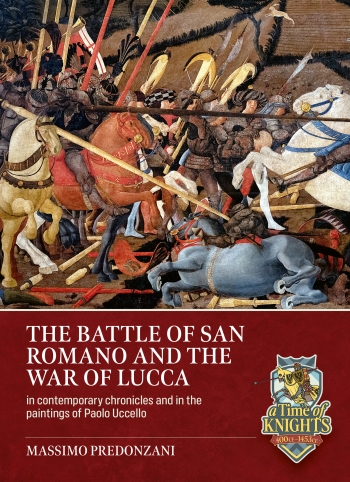
Among the most important engagements of the war were the Battle of the Serchio in December 1430, where the forces of Lucca, led by Niccolò Piccinino, defeated the Florentines, and the Battle of San Romano in June 1432, which resulted in a Florentine victory. San Romano was one of Florence’s few major successes during the conflict and was later immortalised in three celebrated paintings by Paolo Uccello, produced around 1440 to commemorate the victory.
Today housed in major museums in Florence, Paris and London, Uccello’s three paintings provide an important visual record of fifteenth-century warfare, particularly the weapons, armour and military heraldry of the period. Italian armies at the time were composed largely of mercenary troops, with individual companies displaying distinctive colours and symbols on their clothing, standards and equipment. These identifying devices were known as divise, or liveries.
Uccello depicted these divise in remarkable detail. By comparing the paintings with contemporary documentary evidence, the author has been able to identify previously unrecognised figures and shed new light on the men who fought at San Romano. Drawing upon original documents and contrasting accounts of the battle, including important evidence from the Sienese side, this book offers a fresh examination of the battle, its participants and the military culture of fifteenth-century Italy.