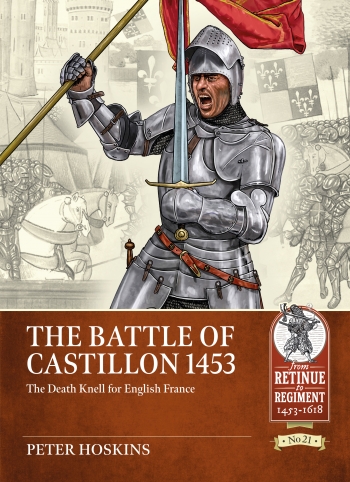
The Battle of Castillon 1453
The Death Knell for English France
Series : From Retinue to Regiment 1453-1618 #21
Author : Peter Hoskins
Print Editions
Paperback
£25.00 £20.00 FREE UK delivery on orders over £30
Despatched within 1-2 working days
Details
General - Pages : 134 | Images : 28 b/w photos, 1 b/w illustration, 8pp colour plates, 8 b/w maps
Paperback - Date of Publication : 5th October 2023 | Size : 248mm x 180mm | ISBN : 9781804513552 | Helion Book Code : HEL1737


Click images to enlarge
The defeat of John Talbot, Earl of Shrewsbury, and the Anglo-Gascon army on 17 July 1453 at Castillon on the River Dordogne, 25 miles east of Bordeaux, was the last of the great battles of the Hundred Years’ War. Thre battle resulted in a catastrophic defeat for Talbot and heralded the rapid collapse of the last vestiges of English power in south-west France. Three months later the last English troops le Bordeaux.
The end of English rule in Gascony brought to an end a period during which, in a little over four years, the French had driven the English from their lands in Normandy and Gascony, leaving the Calais Pale as the only surviving possession in France, a possession that the English Crown would hold for another century. The battle also marked an important step in the evolution of warfare. King Charles VII had brought about major reforms in the French Army, establishing a standing army, and, thanks to the technical and tactical innovations of the Bureau brothers, artillery played a decisive role on the battle field for the first time. To put the Battle of Castillon in perspective the book summarises the origins of the Hundred Years’ War and the ebb and flow of fortunes during the war up to the Treaty of Tours in 1444. It then describes the military reforms of King Charles VII and the innovations of the Bureau brothers in the development of artillery. Shrewsbury, who died in the battle, had a long and successful military career, and was one of the few English commanders to emerge from the final years of the 100 Years War with his reputation intact. He fought during the reconquest of Normandy and, as the commander of the English Army attempting to stem the French tide in Gascony, was a key figure in the later years of the war. His military career is described and the book then recounts in detail the campaigns in Normandy during 1449–50 and in Gascony in 1451 and 1452–3. The battle of Castillon, the decisive action in the French conquest of Gascony, is described in detail. The book concludes with an account of the aftermath of the battle and the final expulsion of the English after the surrender of Bordeaux, three months to the day after the defeat of Shrewsbury at Castillon.
"Much more than the title suggests, it a good narrative of the last decade of the Hundred Years Wars, leading up to the final campaign and the fall of English Gascony. Lots of information on the reorganisation of the French armies that contributed greatly to that outcome and on the development of artillery. There's also an interesting chapter on Talbot's earlier career." Steve Stanley
"...This is a well written and easy to read book, and clearly the author has conducted a great deal of research from a wide range of sources. The book boasts several well presented maps, a fair few photographs of the area as it is today and of preserved artillery pieces, and the usual fabulous central pages containing eight colour plates depicting examples of the soldiers of the time, and banners and coats of arms of some of the main participants. If the late Medieval period and the Hundred Years War number among your interests, whatever the reason, this book should make an enjoyable and rewarding read." carryononupthedale.com
"....Helpful maps show the expansion and contraction of English holdings in France (plus of course the battle itself), and there is a handful of colour plates of figures and shield designs. This is a usefuk overall profile of the end of the Hundred Years War." Miniature Wargames Magazine
"...The author presents it in detail, with the support of numerous maps and illustrations....Among the strong points of the text, we will note the careful description of the battlefield and the study of the responsibilities of the leaders of the two armies for the results of the battles. The book is presented in a clear and pleasant way, with black and white photographs and color drawings." VaeVictus Magazine, No 173 (translated from French)
"...A useful book which works on two levels - as a primer on the HYW and more to the point as a text on the final campaign of that long series of wars. Recommended." Glorious Little Soldier Blog
"...it is very welcome to see a book about a Hundred Year War battle that is not one of the “big three” of Crécy, Poitiers and Agincourt. That it is one from the later part of the war, post Agincourt, that is badly neglected in accessible books in my view, is a bonus....I would bill it as a book about the fall of English possessions in France rather than a book just about the Battle of Castillon. It gives much more space to this than the battle, and that is where its strength is in my view.." Slingshot Magazine Issue 366, Sept/Oct 2026