
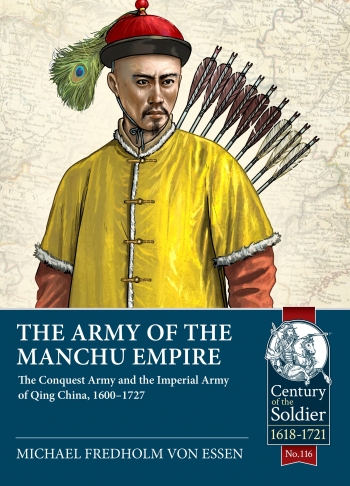
The Army of the Manchu Empire
The Conquest Army and the Imperial Army of Qing China, 1600-1727
Series : Century of the Soldier 1618-1721 #116
Author : Michael Fredholm von Essen
Print Editions
Paperback
£29.95 FREE UK delivery on orders over £30
Despatched within 1-2 working days
Hardback
Out of print
Details
General - Pages : 272 | Images : 138 b/w illustrations, 77 b/w photos, 20 colour plates, 1 b/w map, 7 tables
Paperback - Date of Publication : 24th May 2024 | Size : 248mm x 180mm | ISBN : 9781804513477 | Helion Book Code : HEL1729
Hardback - Date of Publication : 9th May 2024 | Size : 248mm x 180mm | ISBN : 9781804515891 | Helion Book Code : HEL1905


Click images to enlarge
This book describes and analyses the Manchu, or Qing, army in all its aspects. The emphasis lies on the Qing army in the seventeenth and early eighteenth century, because this is the time when the Manchu military system developed its own characteristics and reached maturity. Furthermore, having achieved this and in the process conquered one of the largest empires ever gained, the Qing army changed but little before c. 1850, when the Taiping War marked the beginning of the end of the Qing empire, as well as changed the character of the Manchu military system.
In its heyday, the Qing army achieved a number of significant victories. First, it conquered Ming China. The Qing consistently achieved victories against numerically superior Ming armies. The Qing military operated as combined arms armies, successfully joining the various strengths of cavalry, infantry, and artillery. The Qing army was for cultural and historical reasons particularly strong in cavalry, as could be expected from a power that had incorporated numerous Mongols into its ranks. On the strategic level, this intimate level of cooperation with steppe nomads and the deep understanding thereby achieved of steppe politics and political systems of nomad states, enabled the Qing state to extend its borders further to the north and west than any previous sedentary ruler of China.
In the tropical countries to the south of China, the Qing army experienced both victories and serious losses, especially to disease. In this they showed similarities with the various European armies of the time. The Portuguese colonial troops in southern China proved no obstacle to Qing conquests.
Perhaps the clearest indication of the versatility of the Qing military system was its successful containment of the very active Russian expansion then underway. The two treaties of Nerchinsk in 1689 and Kyakhta in 1727 delimited the Manchu-Russian border exactly where the Manchus wanted it to be, and the border selected by the Manchus remained unchallenged until the second half of the nineteenth century. Indeed, the border delimited at that time forms the backbone of the national borders of the region to this day.
In this book, Michael Fredholm von Essen presents new research on an army and military campaigns previously seldom described in English. He explains the development of the Manchu Conquest and Imperial Qing Armies and details the military system of Qing China, which until 1912 fought a variety of enemies ranging from Ming Chinese, Koreans, Mongols, Tibetans, Gurkhas, Burmese, and Vietnamese to Russians and Western Colonial armies.
"An unusual subject but one presented in an entertainingly well written and scholarly manner. I certainly enjoyed the book and am happy to give it a place in my library."carryingsonupthedale blog
“If you are interested in a period that saw the consolidation of China from basically Korea to Tibet with battles against Chinese, Mongolians, Tibetans, Russians, and others, here's your reference book. Well done. Enjoyed it.” The Historical Miniatures Gaming Society