
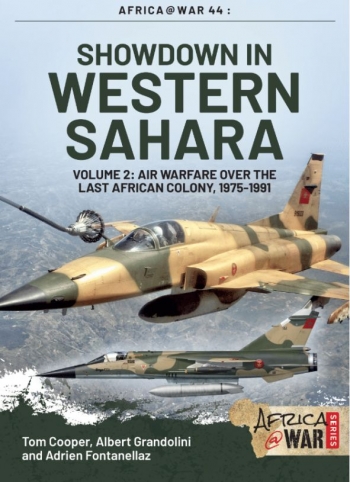
Showdown in Western Sahara Volume 2
Air Warfare over the Last African Colony, 1975-1991
Series : Africa@War #44
Author : Tom Cooper, Adrien Fontanellaz, Albert Grandolini
Print Editions
Paperback
£19.95 FREE UK delivery on orders over £30
Despatched within 1-2 working days
Digital Editions
eBook (pdf) 26.52MB
£12.99 Available for immediate download
Bundles
This book is also available as part of the following bundle
Details
General - Pages : 88 | Images : 129 b/w photos/ills, 8 maps, 23 colour profiles, 7 tables
Paperback - Date of Publication : 15th December 2019 | Size : 297mm x 210mm | ISBN : 9781912866298 | Helion Book Code : HEL1119
eBook - ISBN : 9781915113214
The former colony of Spanish Sahara saw frequent outbursts of tribal and ethnic rebellions while ruled by the colonial authorities in the late 19th and through the early 20th Century. Its vastness and distances essentially dictated the application of air power in response. While most of these events attracted next to no attention in English-language media, the large-scale operations of the Spanish colonial authorities of the late 1950s became notable at least for the final combat deployment of the famous Messerschmitt Bf.109.
Following the Spanish withdrawal from Spanish Sahara in 1975, a major war erupted as Sahrawi nationalists – organized by the POLISARIO front – engaged in guerrilla warfare against Moroccan armed forces deployed to secure the northern part of the country, and Mauritanian forces deployed in the south.
Characteristically for this period, POLISARIO’s insurgency was often misinterpreted in the West as ‘Soviet-influenced’, although the rebels never adapted any related frameworks for their operations and tactics, such as those of Mao Zedong. On the contrary, while Algeria at least tolerated their bases on its soil, it was Libya that provided most of the support for the insurgency, eventually enabling it to defeat the Mauritanian military, slightly over a year later. Combined with POLISARIO’s raids deep into Mauritania this prompted France to launch a limited military intervention in support. While tactically successful, this proved insufficient: Mauritania withdrew in 1979 after signing a peace treaty.
Morocco continued fighting a series of bitter campaigns through 1979 and 1980, until rising costs and casualties prompted its government into developing an entirely new strategy. Construction of extensive earthen fortifications eventually slowed the war down to one of low intensity, only sporadically interrupted by insurgent attempts to achieve at least local successes. With both sides realizing that no solution through an armed conflict was possible, a cease-fire agreement was signed in 1991. However, this conflict still remains unresolved: it merely shifted to civilian resistance.
Warfare in Western Sahara has in many ways become exemplary for modern-day counter-insurgency efforts in Africa and elsewhere. This conflict has been falsely declared as a part of some larger, external conflict – the Cold War; in regards of the concept of an insurgency applying motorized forces to deliver often spectacular ‘hit-and-run’ attacks; and in regards of a conventional military reacting with a combination of earth berms and air power.
".....This volume deals with the sequence of clashes from 1975 to 1991 and, thanks to the competence of the authors, the complex scenario is illustrated in a clear and comprehensive manner. The rich and well-kept iconographic section, characteristic of the series, includes largely unpublished photos, tables & maps." Marco de Montis, Panorama Difesa July 2020
"The two volumes can be considered a gap-filling work because very few publications have been made in English about military events in the region. Moreover, in relation to air warfare, it has been the only very detailed work published so far in which the reader can get relevant information about the socio-economic and geo-political background of the region in addition to learning about military events. It is also useful that the authors presented not only air but also land fighting and their means. A special positive of the books is that the authors did not take a position on any of the parties involved in the conflict, but maintained their neutrality and made purely professional statements on the research topic." Dr. Janos Besenyo, Terrorism and Political Violence Vol 33 No 1
"...provides a good holistic look at the situation in the Western Sahara, designed for either the casual observer or as an introductory text to a future specialist." Air Power History