
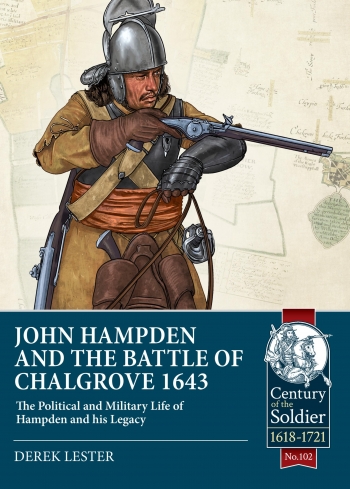
John Hampden and the Battle of Chalgrove 1643
The Political and Military Life of Hampden and his Legacy
Series : Century of the Soldier 1618-1721 #102
Author : Derek Lester
Print Editions
Paperback
£29.95 FREE UK delivery on orders over £30
Despatched within 1-2 working days
Details
General - Pages : 176 | Images : 9 b/w illustrations, 1 b/w photo, 9 maps
Paperback - Date of Publication : 12th April 2023 | Size : 248mm x 180mm | ISBN : 9781804511961 | Helion Book Code : HEL1625
On the 16th of June 1643, Prince Rupert slipped out of Royalist Oxford with the intention of beating up Parliamentary quarters and hoping to capture a Parliamentarian convoy carrying some £21,000 in coin. Having failed to intercept the convoy, the Royalists headed back to Oxford. A Parliamentarian cavalry column caught up with the Prince and his troops outside the small Oxfordshire village of Chalgrove, early in the morning of the 18th of June. During the short engagement noted Parliamentarian Colonel John Hampden was wounded, and although he was able to leave the field, he was to die six days later of his wounds.
His opposition to the King’s attempts to impose taxation prior to the war, had made him a national figure. His trail for non-payment of the Ship Money Tax turned him into a celebrity. He was one of the five MP’s that the King attempted to arrest in January 1642. His was a grievous loss to the Parliamentarian cause.
Hampden’s mortal wounding at Chalgrove in June 1643 remains a matter of controversy due to the reliance of existing accounts upon tainted evidence, originating from the account of The Earl of Clarendon in the 17th century, through the partisan interpretations in the 18th century, continued into the nineteenth and twentieth centuries. The author’s research in the Bodleian Library uncovered the contemporary account used by Clarendon, revealing that the accepted version of the Battle of Chalgrove, published in his celebrated History of the Rebellion (London 1702), bore little relation to the original text. The fictions and propaganda incorporated in this published text by Clarendon’s son, Lawrence, continue to mislead historians. The memory of Hampden was exploited for partisan purposes by several authors in the 18th century, with new fictions and falsified evidence perpetrated in the 19th century by Hampden’s equally partisan biographer, Lord Nugent, continued by other authors such as Eliot Warburton. These accounts have been accepted by modern authors up to and including the most recent biography of Hampden in 1976, and continue to mislead modern interpretations of the Chalgrove battle and battlefield. The fictions and the motivations underlying the accounts are examined in detail in this study, including those related to Hampden’s funeral and the exhumation by Lord Nugent of what he claimed to be Hampden’s body. In presenting a new account of Chalgrove based on wide research, including estate maps and in-depth knowledge of the terrain, the author challenges the accepted version of the battle and its consequences, and points to the need for a re-evaluation of Clarendon’s History of the Rebellion. Hampden’s wider legacy, not least in North America, is also examined in a major contribution to the historiography of the First Civil War. Voltaire proclaimed, ‘All gazettes of Battles are Liars, the English perhaps, the least of any’ – the example of Chalgrove suggests he was mistaken. The author’s text establishes Hampden’s significance at the time and since and sets out the cause and course of the battle, its military and political consequences, and the subsequent historiography. The appendices reproduce the key primary texts.
"....This is a good piece of scholarship with plenty of throught-provoking conclusions and it may be that Lester's interpretation of events at Chalgrove is right. He certainly thinks so and he is convincing. You must read the book, preferably walk the field, and make up your own mind." Battlefield Magazine
" ....Without a doubt this book adds to our knowledge of the Civil Wars and no future biography of Hampden is possible without reference to it - perhaps especially the original source of Clarendon's account....For anyone interested in the Civil Wars this will make an excellent addition to your bookshelf. It hopefully settles many of the fictions and half-truths of Hampden's death, but overall this is more a biography of Hampden and notes on this political relevance than a military book." Journal of the Society for Army Historical Research, 2024 Vol 102 No 411