
Great Britain and the Defence of the Low Countries 1744-1748
Armies, Politics and Diplomacy
Series : From Reason to Revolution 1721-1815 #116
Author : Alastair Massie

Print Editions
Paperback
£29.95 FREE UK delivery on orders over £30
Despatched within 1-2 working days
Hardback
£35.00 FREE UK delivery on orders over £30
Despatched within 1-2 working days
Digital Editions
eBook (pdf) 10.13MB
£19.99 Available for immediate download
Details
General - Pages : 268 | Images : 9 b/w illustrations, 7 maps
Paperback - Date of Publication : 9th October 2023 | Size : 245mm x 170mm | ISBN : 9781804513378 | Helion Book Code : HEL1719
Hardback - Date of Publication : 9th October 2023 | Size : 245mm x 170mm | ISBN : 9781804513385 | Helion Book Code : HEL1720
eBook - ISBN : 9781806720965




Click images to enlarge
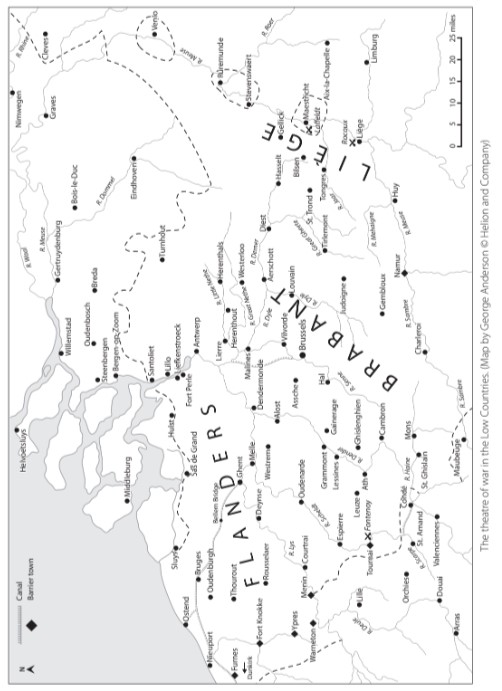
By revealing how the progress of the fighting in the Low Countries influenced politics back in London, and how political decisions reached, as a consequence, affected the course of military operations, this book fuses together both an analysis of the military campaigns and an examination of their political management. Amongst much else, it will show how the weakness of Lord Carteret’s position within government during 1744 – and a consequent lack of guidance from him – reinforced Marshal Wade’s natural caution in the field, a caution that so exacerbated inter-allied tensions as to lead to a nugatory campaign, fuelling dissension within the ministry at home. Carteret’s resulting removal from power by his rivals presaged an attempt to reach a new political settlement, but the policy-change required – regarding Britain’s employment of its Hanoverian troops – had a disastrous bearing on the conduct of the war in the Low Countries. Indeed, were one mischievous, it could be argued that it was William Pitt who lost the Battle of Fontenoy.
Military failure now changed the government’s preoccupations. With the threat of French invasion and the prospect of a Jacobite uprising, the question was whether home defence or the war in Flanders were to take priority. The fate of a besieged Ostend became the initial focus of this concern, as politicians and military commanders engaged in a tug of war over its reinforcement. Later, the disagreements over whether troops were needed more in Brabant or Scotland reached their climax in a tussle over the destination of Britain’s Hessian auxiliaries, indirectly leading, on the one hand, to the resignation of a government in London and, on the other, to the fall of Brussels.
In 1746, the pattern of defeat in the Low Countries continued. London’s decision to deny overall command of the British-paid contingent, and full general’s rank, to Sir John Ligonier helped contribute to a fracturing of the allied army before the Battle of Rocoux, an outcome instrumental in securing French victory. The following year, another reverse at the Battle of Laffeldt and the subsequent fall of Bergen-op-Zoom did not, surprisingly enough – and for diplomatic reasons that are explained – lead to a British re-evaluation of the viability of continuing the war (despite an important element within the ministry hoping it might). Nevertheless, the pertinacity of the leading proponent of war measures, the Duke of Newcastle, was shaken early in 1748 as the reality of a dire military situation made itself apparent. The progress of peace talks at Aix-la-Chapelle thereafter mirrored exactly the path of impending military catastrophe, with the mighty fortress of Maestricht firmly in French sights.
This is an important study of Britain and the War of the Austrian Succession that does away with the tendency of a past historiography to compartmentalise the subject into distinct military, political and diplomatic silos.
“If you have […] a yen for the political and diplomatic maneuverings of this period, here's your book.” Historical Miniatures Gaming Society
"Cutting right to the chase, this is a truly absorbing and gripping account of Britain’s role in the War of the Austrian Succession (1744–1748). The author explores the consequences of the political decision making and management of the war on the outcome of the military operations, and indeed how the failure of the operations in the field influenced the politicking back home. ...This is another fine addition to Helion’s From Reason to Revolution 1721–1815 series and one well deserved of a space on my bookshelves." carryingsonupthedale.com
"...Written with clarity, it is a major contribution to our understanding of the war at the political and operational levels." Journal of the Society for Army Historical Research, 2024 Vol 102 No 411