
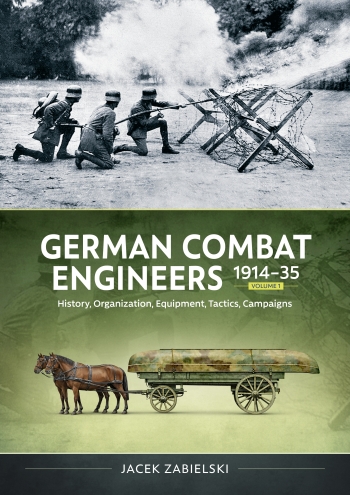
German Combat Engineers 1914-1935 Volume 1
History, Organization, Equipment, Tactics, Campaigns
Author : Jacek Zabielski
Print Editions
Paperback
Not yet published - in Spring 2027 list
Details
General - Pages : 176 | Images : 250 b/w photos, 20 colour illustrations, 3 colour profiles, 1 colour map, 2 graphs
Paperback - Size : 297mm x 210mm | ISBN : 9781806725182 | Helion Book Code : HEL2349
Across rivers, through fortifications, under wire, and beneath the earth itself, German combat engineers—the Pioniere—fought a war few remember but none could have been won without. From the muddy trenches of Flanders to the shattered forests of the Eastern Europe, these specialist soldiers shaped the course of modern warfare with sweat, skill, and steel.
German Combat Engineers brings their hidden world to light. Drawing on rare photographs, archival documents, and detailed technical research, this book traces the evolution, organization, and combat role of Germany’s engineer troops from the pre- 1914 Imperial Army through the crucible of the First World War. Readers will discover how Pioniere built bridges under fire, carved tunnels deep beneath enemy positions, stormed strongpoints with explosives and flamethrowers, and supported the first assault troops in history—the legendary Sturmtruppen.
Inside are vivid accounts of engineer operations on the Western and Eastern Fronts; technical studies of weapons, uniforms, and equipment; and clear explanations of the many specialist branches—field pioneers, fortress pioneers, railway engineers, flamethrower units, mortar crews, searchlight sections, bridging trains, and more. Richly illustrated and meticulously researched, the book reveals how these highly trained soldiers combined construction and destruction in equal measure, shaping the battlefield long before the infantry arrived.
The book also follows the story beyond 1918. In the postwar Reichswehr, engineers survived as a small but elite corps, preserving hard-won technical knowledge despite the strict limits of the Treaty of Versailles. Former wartime pioneers became instructors, designers, and officers who quietly shaped Germany’s interwar doctrine. Their experience in fortification, mobility, demolitions, and combined-arms support helped lay the engineering foundations later expanded by the Wehrmacht.