
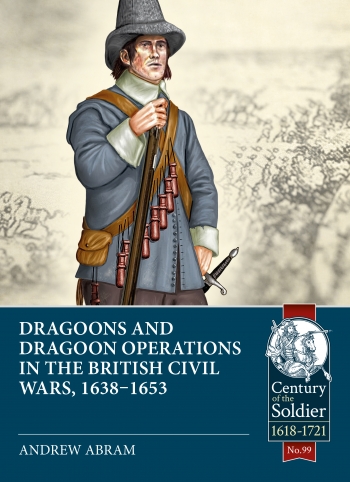
Dragoons and Dragoon Operations in the British Civil Wars, 1638-1653
Series : Century of the Soldier 1618-1721 #99
Author : Andrew Abram
Print Editions
Paperback
£35.00 FREE UK delivery on orders over £30
Despatched within 1-2 working days
Digital Editions
eBook (pdf) 8.64MB
£19.99 Available for immediate download
Details
General - Pages : 334 | Images : 36 b/w illustrations, 5 b/w photos, 4 maps, 9 tables
Paperback - Date of Publication : 22nd March 2023 | Size : 248mm x 180mm | ISBN : 9781804511954 | Helion Book Code : HEL1624
eBook - ISBN : 9781806721160
This book explores the concept, raising, equipping, composition, organization, and operational role of dragoons during the British Civil Wars. It also provides information about known dragoon units and their activities, across a relatively broad geographical and chronological range, and challenges previous interpretations in the light of more recent research. As such, this represents the first sustained study of early-modern dragoons. These soldiers were an essential part of seventeenth-century armies, even if some contemporaries reflected uncertainties about their precise function. Arguably, as part of the wider context of ‘military revolution’ in the tactics and prosecution of war in Europe, during the Thirty Years’ War in particular, the medium harquebusiers and mounted infantry continued to evolve. Although dragoons occasionally delivered mounted charges, their distinctive character dictated that they were employed in operations where mobility was essential – the seizing of bridges and strongholds, raiding, reconnaissance, patrolling and foraging. Dragoons were also used for defending hedges and passes, specialist siege operations, and in providing covering fire for both the horse of foot.
In terms of organization, various regiments of dragoons and autonomous companies (referred to also as troops) were recruited by all armies, although some came and went, and several units remain obscure, both in their origins and history. Some companies were attached to regiments of Horse, following the continental practice, which was also adopted by the Scottish armies. Some authors have suggested that civil-war dragoons were a fighting elite, who were often commanded by professional soldiers and recruited from veterans of other conflicts. There is some truth in this – officers such as Prince Rupert, Sir Arthur Aston and Colonel James Wardlaw led and promoted their role – although there are various examples of inexperienced, and poorly equipped and officered dragoon units during the early stages of the wars. Nevertheless, some military experience is evident from the early stages of the fighting in England, when some Royalist dragoons seemed better trained and disciplined than the rest of the army. For the Parliamentarians, many recruits were obtained in London from returning veterans and foreign professionals. Among Sir William Brereton’s dragoons, some captains were commissioned in the capital, and in 1642 most of the recruits enlisted there, possibly in part from Dutchmen or from British soldiers returning from abroad. Moreover, Colonel Hugh Fraser’s Covenanters were built around ‘four complete companies’ returned from continental service, whilst the regiment was considered the ‘stoutest’ in the army.
This book therefore covers the following areas: the origins and role of dragoons; combined arms tactics and specialist operations; organization and composition of dragoon units; pay and quarter; arms and ammunition; standards, equipment and clothing; horses, equine care, saddlery and fodder; the Oxford Army; the Earl of Essex’s Army; the Eastern Association Army; the New Model Army; and the role of dragoons in regional warfare.
"....Wargamers who like to indulge in the sort of accountancy required to calculate the costs of raising, equipping and paying their armies, as explained by Bruce Quarrie in Napoleon’s Campaigns in Miniature, will find exactly what they need. Others, who prefer to focus on the low-level local actions, raiding and seizing of supplies that were a feature of the British Civil Wars, as depicted in The Perfect Captain’s Tinker Fox campaign game, will appreciate the details of individual captains and their companies of dragoons in the final section on Regional Warfare: Cheshire and the Welsh Borders." Arthur Harman, Miniature Wargames
"This is a tremendous book and obviously the result of considerable primary source research....To describe this as a comprehensive study would be something of an understatement.....This is very definitely a book for anyone with an interest in the mid-seventeenth century to add to their library." Arquebusier
"The book is well written and an engaging read, and furthermore is really interesting, insofar that I lost myself in it for several hours when reading it for this review. The narrative is supported by a wide range of illustrations and several tables. Some are contemporary images, others photographs of present-day historic locations that feature in the text...I am not aware, and stand to be corrected, of any other authors who have written such a detailed account of this rather overlooked subject; traditional views often hold dragoons in some level of contempt when compared to the more dashing cavalrymen, but it’s all very ‘apples and pears’. Prince Rupert among many commanders understood and utilised their unique skills both on and off the battlefield, and having read this book I am now much more appreciative of the importance dragoons played in the Civil Wars. This is yet another book worthy of a place on my groaning bookshelves." Colin Ashton, carryingsonupthedale.com
"The author has always excelled in his research, and if I say there are extensive details on every recorded Dragoon unit, it gives you an idea what to expect. With the normal format of chapters on recruitment, organisation, equipment, and horse flesh before going into the unit histories, it is indeed a joy to read....If you buy one ECW book this year, make it this one!" Steve Stanley
"For anyone interesting in ECW (or BCW) or especially history of dragoons, this book is clearly ‘must have’ and it is worthy addition to their collection." Michal Paradowski