
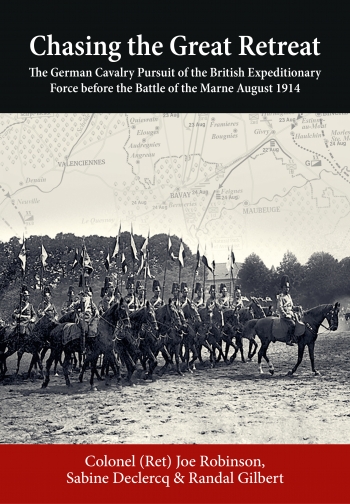
Chasing the Great Retreat
The German Cavalry Pursuit of the British Expeditionary Force before the Battle of the Marne August 1914
Author : Sabine Declercq, Randal Gilbert, Joe Robinson
Print Editions
Paperback
Out of print
Digital Editions
eBook (epub) 5.54MB
£14.99 Available for immediate download
eBook (pdf) 11.21MB
£14.99 Available for immediate download
Details
General - Pages : 188 | Images : 27 b/w photo, 15 maps
Paperback - Date of Publication : 11th March 2022 | Size : 245mm x 170mm | ISBN : 9781915070838 | Helion Book Code : HEL1466
eBook - ISBN : 9781804511121
Written as a sequel to the award-winning German Failure in Belgium, August 1914: How Faulty Reconnaissance Exposed the Weakness of the Schlieffen Plan (2019), which won the Tomlinson Book Award for best First World War English language book in 2020, this volume stands alone as the German army chases the well-documented ‘Great Retreat’. We focus on the German side of the retreat of the British Expeditionary Force (BEF). We show that the Great War should have ended on 23 August 1914 but, due to the ‘fog and friction of war’, as explained by General Carl von Clausewitz, it did not. So, ‘Chasing the BEF’ was born. This is an incredible story of missed opportunities made more astonishing by the amount of propaganda extolled by some British authors. This propaganda line generally purported the story that British firepower dealt a great blow to the German army at the Battle of Mons. Clearly in their eyes, the British won that battle. Much is told about the British soldiers’ ability to fire 15 rounds of aimed shooting in a minute, which allegedly the Germans mistook for machine-gun fire. This is a myth that many readers grew up learning. Britain, in fact, lost the Battle of Mons and should have lost the war on 23 August. Germany missed a wide-open door that would have spelled disaster for the BEF and the entire Left Flank of the French army.
We focus on the role of the German cavalry. This arm is seriously understudied and has had little place in some official histories. In general, both British and German works ignore the role the cavalry played in the war. We are talking about the Right Wing of the German army only, consisting of the German First Army, Second Army and two cavalry formations known as Höherer Kavallerie-Kommandeur (HKK 1 and HKK 2 ). The HKK were ad hoc organisations that had never been tested before the war. They are often wrongly referred to as a cavalry corps – the cavalry did not become a corps until 1915 – but neither were they similar to an infantry corps. However, many authors do not understand the concept of the HKK and therefore do not address the cavalry in operational manoeuvres. This oversight is truly bizarre: The most mobile forces in warfare are given short shrift. Why?
"Most of us know the story of the initial German juggernaut-like offensive that began World War One, which ground to a halt in the face of a British army that had retreated but then turned to give the Germans a bloody nose. It was a great British victory in the face of overwhelming odds, right? Maybe not. The authors in this book argue that not only was this a defeat, but that it should have ended the war if it wasn't for some conspicuous German cavalry errors. They therefore follow the German cavalry to see what went wrong and why - who doesn't want to read about and wargame that? This is probably the best phase for wargaming WWI with both armies mobile and obstinate defence against a seemingly relentless assault. Now we have a clear role for the German cavalry, this becomes even more interesting." Wargames Illustrated, Issue 410, Feb 2022
"... a worthy addition to the literature that already exists on the Battle of the Frontiers in August 1914..." The NYMAS Review
"...these three non-British authors bring a refreshing look at the role of the BEF...this books gets my default praise for Helion publications. Always beautifully produced, with good maps and, if a little pricey, worth every penny!" Stand To! No 128, Oct 2022
"This masterful and interesting analysis of German cavalry use in 1914 includes a goodly portion of German infantry and artillery movements during the wheel towards Paris...The discussion of German logistics arrangements and reality is excellent." Historical Miniatures Gaming Society
"The book’s day by day reporting of unit placements, confused orders, and missed opportunities is a treasure source. Each day’s report is illustrated with a daily map." Roads to the Great War
"This is a great book for those interested in the German advance in 1914 and seek an alternative to the accepted narrative that the British won at Mons. The author also maintains that the Germans could have won the entire war on 23rd August 1914. To find out why, you will have to read the book!.....This is a well-researched and thought-provoking book, well written and containing many opportunities for constructing historical scenarios. Some of the arguments deployed might be considered a stretch but they are logical and well-reasoned. It is very strongly recommended for all who have an interest in the opening moves of 1914." Martin Pike, Miniature Wargames magazine
"The book may be relatively short at 188 pages, but it is certainly dense in terms of the information covered....Helpfully a glossary and appendix detailing the German cavalry units involved are provided. The bibliography also provides a handy selection of many German sources, should the reader wish to further expand their knowledge of the German perspective." ww1geek.com