
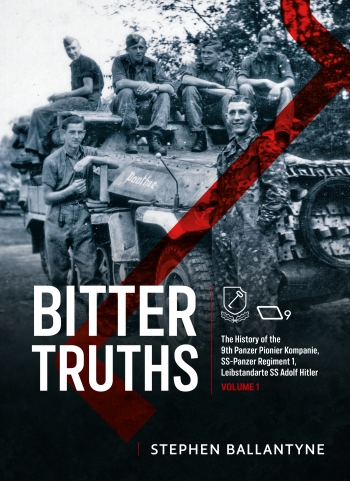
Bitter Truths Volume 1
The History of the 9th Panzer Pionier Kompanie, SS-Panzer Regiment 1, Leibstandarte SS Adolf Hitler
Author : Stephen Ballantyne
Print Editions
Hardback
Not yet published - in Spring 2027 list
Details
General - Pages : 456 | Images : 430 b/w photos & maps, 15 colour photos, 6 tables
Hardback - Size : 305mm x 222mm | ISBN : 9781806724932 | Helion Book Code : HEL2324
Germans from all walks of life served during the Second World War believing that they were simply doing their duty. In doing so, however, they were also serving the aims of the Nazi state. Bitter Truths: The History of the 9th Panzer Pionier Kompanie of the LSSAH Panzer Regiment examines the battles, personnel and weapons of this Waffen-SS unit.
Volume 1 covers the period from the unit’s formation in August 1940 to its departure for Ukraine in November 1943. Initially formed as the 3rd Pionier Kompanie of the LSSAH Pionier Bataillon, it served in the Balkans and took part in Operation Barbarossa in the Soviet Union. In January 1943, it was transferred to the Panzer Regiment and reorganised as a self-propelled, armoured Panzer Pionier Kompanie equipped with SPWs. From February 1943, it fought near Kharkov and continued to serve until the final rearguard actions in Austria in May 1945.
At full strength, the Kompanie comprised 210 men, but casualty lists reveal a substantial turnover of personnel during the war. Of the estimated 1,000 men who served with the unit, almost 600 have been identified. Their varied stories are told through hundreds of original documents and previously unpublished photographs. Only a handful of the original members remained with the Kompanie throughout the war.
The unit was involved in some of the conflict’s darkest episodes, including the Malmedy Massacre of December 1944. Bitter Truths seeks to construct a balanced and thoroughly documented account of the Kompanie’s wartime service. By recording the experiences of its members, it attempts to understand the men who served Nazi Germany during one of the darkest periods in European history.