
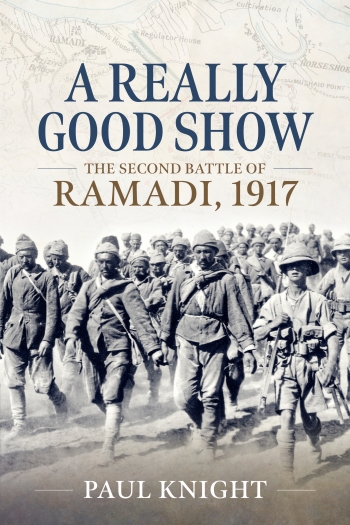
A Really Good Show
The Second Battle of Ramadi, 1917
Author : Paul Knight
Print Editions
Paperback
£25.00 FREE UK delivery on orders over £30
Despatched within 1-2 working days
Details
General - Pages : 198 | Images : 24 b/w photos, 3 b/w maps, 5 b/w illustrations, 2 tables
Paperback - Date of Publication : 2nd October 2026 | Size : 234mm x 156mm | ISBN : 9781804519165 | Helion Book Code : HEL2094
How did an Anglo-Indian division, fighting its first battle in an obscure sideshow and under some of the most challenging environmental conditions imaginable, fight and win what was arguably the most perfectly executed battle of the First World War?
Histories of the Mesopotamia (Iraq) Campaign are inevitably overshadowed by the disaster of the Siege of Kut. Yet the battles fought both before and after the siege demonstrate that British commanders understood the nature of the conflict and had developed the correct tactical approach. Unfortunately, the extreme environmental conditions repeatedly prevented them from delivering a decisive blow against the enemy, resulting in further battles – and further casualties.
The 15th (Indian) Division was a wartime formation, comprising newly raised Indian battalions and British Territorial units originally sent to India to replace Regular Army units deployed to Europe or Gallipoli. The division was supported by the 6th Cavalry Brigade, another Anglo-Indian formation, as well as Rolls-Royce armoured cars, watercarrying lorries and aircraft. Together, these forces brought the technology and tactical thinking of 1917 together to deliver a remarkably modern, manoeuvrist battle.
The tactics employed a fixing force to distract and pin the enemy while another force conducted a flanking attack. At the same time, cavalry – and later armoured cars – made a deeper flanking movement designed to cut off the enemy's retreat. Such manoeuvres often required a long, arduous movement through waterless desert to reach the blocking position, usually where the road and river lay in close proximity. This was warfare that combined mobility, deception, firepower and careful coordination – and demonstrated just how effective modern tactics could be, even in the most unforgiving conditions of the Mesopotamian theatre.